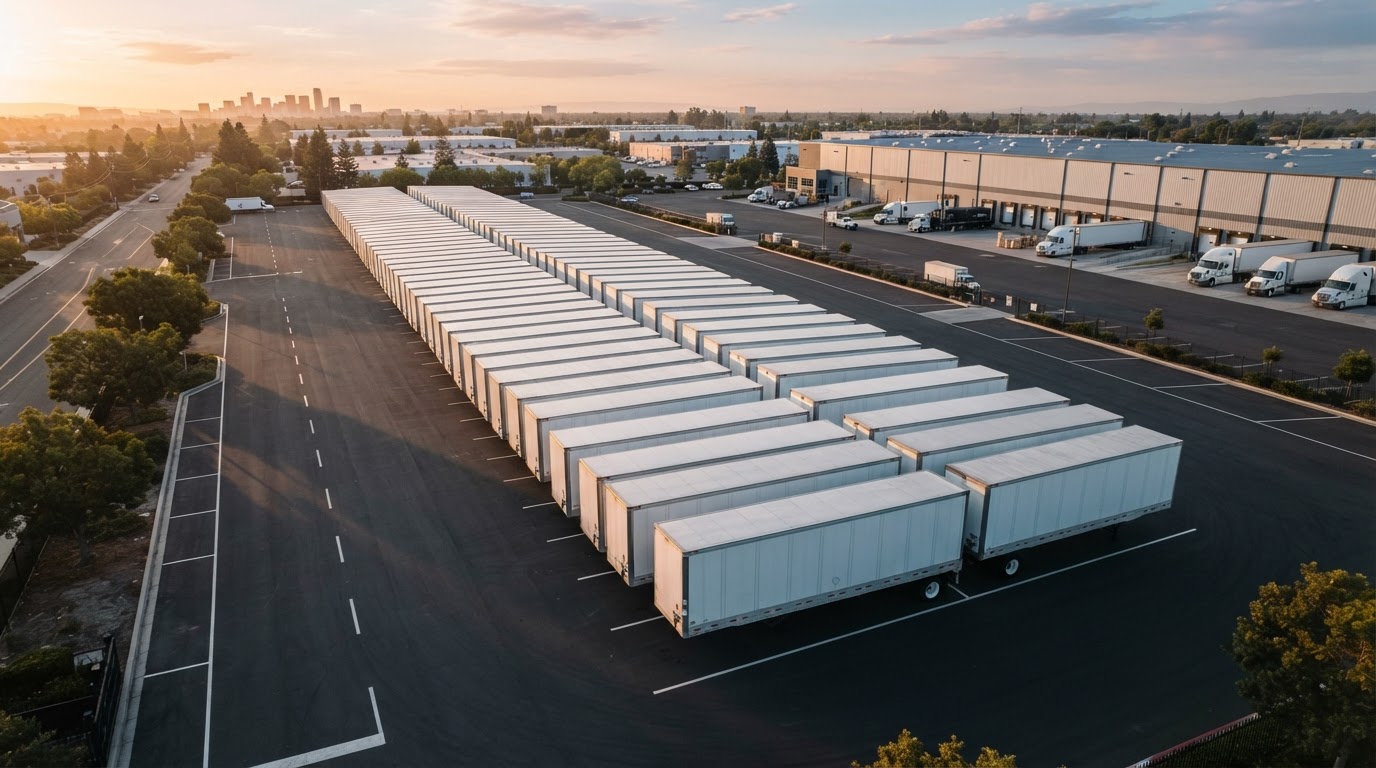
The $250K/Month Trailer Leasing Business Model
How one entrepreneur reportedly built a 300-trailer rental operation without purchasing the fleet — and how we're exploring the same model in Houston.
Reported fleet scale
Reported revenue
Reported net profit
Control the Equipment. Rent the Equipment. Build Recurring Revenue.
This model is about controlling access to trailer inventory and connecting it to trucking customers who need equipment. Instead of buying a fleet upfront, we pursue an authorized master lease, sublease the equipment to paying operators, and keep the recurring spread.
Access trailer inventory
Establish supplier relationships that unlock access to commercial 53-foot dry van trailers — without owning a fleet.
Place qualified trucking customers
Use lead generation and marketing to connect available trailers with owner-operators and small fleets who need equipment now.
Earn recurring monthly spread
Capture the difference between supplier cost and customer rental rate as a recurring monthly margin or commission.
One trailer. Three parties. A recurring spread.
The supplier owns it. Daily Nest controls it under an authorized lease. The customer pays to use it. The difference between supplier cost and customer rent is the recurring margin.
Owns the trailer
- Establishes a master lease with Daily Nest
- Extends approved credit and payment terms
- Authorizes subleasing in writing
Controls the equipment
- Leases and controls the equipment
- Contracts with the trucking customer
- Collects deposits & weekly rental payments
- Manages marketing, qualification & billing
- Pays the supplier per the master lease
Uses the trailer
- Needs a trailer to operate
- Signs a commercial rental agreement
- Provides required insurance
- Pays $180 weekly to Daily Nest
“The supplier owns it. Daily Nest controls it under an authorized lease. The customer pays to use it.”
How WMac and Mike bring the model to life.
Daily Nest drives the business systems, supplier strategy, marketing, and customer acquisition. Mike supports the Houston field execution, local coordination, and supplier-side logistics. Together, the model stays lean, local, and scalable.
This opportunity works because it combines centralized business execution with local operational support. Daily Nest handles supplier strategy, customer acquisition, automation, billing, and growth systems. Mike provides the local Houston presence needed for supplier relationships, trailer coordination, inspections, and pickup logistics.
WMac / Daily Nest Group
Business systems and growth engine
- Identify and negotiate supplier relationships
- Establish the master lease structure
- Handle marketing and customer acquisition
- Build and manage Facebook Marketplace / Meta lead flow
- Operate CRM, AI automation, and follow-up
- Qualify renter inquiries and process applications
- Coordinate agreements, deposits, and weekly billing
- Track economics, utilization, and growth opportunities
Mike / Houston Operations
Local field support and execution
- Help identify Houston trailer suppliers and local opportunities
- Support yard visits and local supplier communication
- Confirm trailer availability and condition
- Assist with pickup, return, and local coordination
- Help verify trailer photos, inspections, and logistics details
- Provide local operational support if issues arise
- Support scaling once the first units are proven
Our execution flow
Supplier Outreach
Daily Nest and Mike identify Houston-area trailer suppliers and explore who may allow an authorized master leasing relationship.
Master Lease Structure
Daily Nest works to secure the business arrangement, pricing, terms, and written subleasing permission.
Inventory Confirmation
Mike helps verify available trailer units, condition, photos, and local pickup logistics.
Customer Acquisition
Daily Nest launches lead generation through Marketplace, Meta, and direct inquiry handling.
Qualification and Payment
Daily Nest qualifies trucking customers, coordinates documents, collects deposits, and sets up weekly billing.
Pickup and Active Rental
Mike supports local coordination while Daily Nest manages the customer relationship, collections, and ongoing account flow.
Why this structure works
Lean Setup
No need for a large office, staff, or owned fleet to begin validating the model.
Centralized Systems
Daily Nest can run lead flow, automation, billing, and customer communication from one operating system.
Local Presence
Mike gives the model real Houston execution capability where supplier and trailer coordination actually happens.
Scalable Structure
Once one trailer works, the process can be repeated across additional units and supplier relationships.
Execution Principle
The model stays simple.
“We do not start by buying trailers. We start by securing supplier access, verifying the economics, placing paying customers, and proving the process one trailer at a time.”
This is a controlled Houston pilot built around execution discipline, not hype.
The supplier's credit terms can unlock the model
The featured entrepreneur reported operating with a ~650 credit score, no supplier deposit, and deferred supplier billing — collecting customer rent before the supplier bill came due.
- Day 101Supplier
Provides access to a trailer under approved terms.
- Day 102Customer
Signs an agreement and pays a deposit plus initial rental payment.
- Weekly03Customer
Continues paying recurring rental charges to Daily Nest.
- Supplier date04Daily Nest
Pays the leasing company according to its negotiated agreement.
Historical reported terms — not guaranteed current offers
- Credit score
- ~650 (self-reported)
- Supplier deposit
- Reportedly none required
- Supplier billing
- Reportedly deferred
Customer deposits are refundable liabilities — not earned profit or unrestricted working capital.
The objective is favorable payment timing — not purchasing trailers with borrowed money.
Spreads are collected weekly while supplier obligations fall on a negotiated schedule. The edge is timing and access — not leverage on equipment.
Model the spread yourself
Drag the inputs to see how fleet size, rental rate, supplier cost, and utilization shape the recurring monthly economics.
45 of 50 trailers actively rented · 5 idle. Supplier lease costs continue on idle units, creating $1,750/mo of drag not covered by customer rent.
Customer revenue
$35,100
45 units
Supplier expenses
$17,500
50 units
Additional op. expenses
$6,250
50 units
Monthly gross spread
$19,350
rented units only
Monthly operating contribution
$11,350
Before company overhead, marketing, taxes, major losses, and extraordinary expenses. Gross spread is not net profit.
Monthly operating contribution by fleet size
Using your current inputs above
Not net profit
Illustrative only. Actual pricing, supplier terms, insurance, downtime, and collections must be verified before committing capital. Inputs are assumptions, not offers.

Truckers need equipment to generate income
Owner-operators and small fleets already rent trailers routinely. The demand is real and recurring — which is exactly what makes the supplier-side arbitrage worth exploring.
Limited upfront capital
Buying a trailer costs tens of thousands. Renting preserves cash for operations and growth.
Seasonal or expanding business
Demand shifts with freight cycles. Renting lets operators flex capacity up and down without owning idle assets.
Need for equipment now
An operator with a truck but no trailer loses income every day. A rental gets them rolling fast.
Six reasons it's worth a closer look
Recurring revenue
Monthly rental spread creates predictable, repeatable cash flow rather than one-time transactions.
Potential low upfront capital
Accessing existing supplier inventory can avoid the heavy capital outlay of owning a fleet.
Strong demand from operators
Owner-operators and small fleets rent trailers routinely — the equipment is already in demand.
Marketed online
Demand can be generated through online channels that reach buyers wherever they operate.
Coordinated remotely
Lead capture, follow-up, and coordination can be run as a system without a large local footprint.
Houston is a strong logistics market
Houston and Dallas sit on dense freight corridors with constant demand for trailer capacity.
We're not starting from zero
We already have the tools to market, capture leads, automate follow-up, and manage customer communication — the exact systems this model runs on.
Local Houston operating partner
Daily Nest Group · on-the-ground relationships
Lead generation systems
Built-in funnels that capture inbound demand.
CRM & follow-up automation
Nurture leads until they're ready to rent.
AI voice & response tools
Always-on, automated customer communication.
Online marketing capability
Paid and organic demand generation.
A three-phase proof of concept
Validate supplier partnerships
Confirm which suppliers will lease or share 53-foot dry van inventory, and on what terms.
Test market demand
Run lead generation and collect real trucking-operator leads to confirm customers will rent at projected rates.
Place the first rental customer
Match a lead to an available trailer, complete a rental, and confirm the real economics end-to-end.
The initial objective is to validate the model without committing large capital — de-risking each assumption before scaling.
Responsible before it's repeatable
A credible proof of concept names the risks up front. These are the conditions we verify before scaling anything.
Supplier approval matters
Every supplier has its own terms. Subleasing or re-renting may require explicit written permission before placement.
Subleasing may not always be allowed
Some contracts prohibit assigning or sub-renting inventory. Terms must be read and confirmed, not assumed.
Insurance & contracts must be verified
Liability, damage, and loss provisions need clear contracts and insurance before any customer takes a trailer.
Begin as a small, controlled pilot
Start with one or two units to validate the path before committing meaningful capital or volume.
Worth exploring as a Houston-based pilot
If the supplier relationships and economics check out, this could become a scalable recurring-revenue lane alongside our existing business activities.